



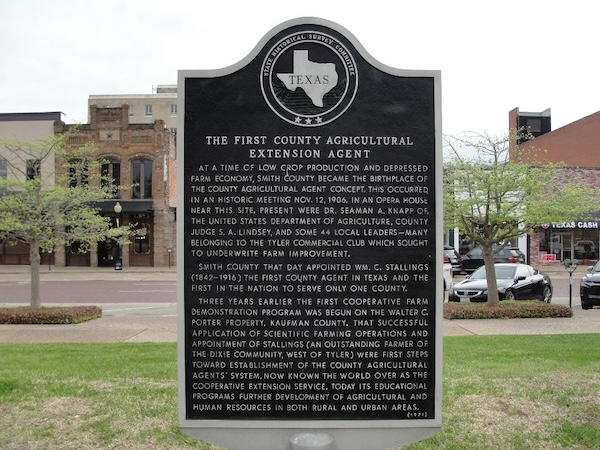
Smith County had the first county agent in America.
August 26, 2026 - I’m proud to be the only county agent in America not only serving the county he was born in, but in the very county that hosted the first county agent in the nation.
When people think about national agricultural milestones, they often picture Washington, D.C., or one of America’s major land-grant universities. Few realize that one of the most important developments in agricultural education and outreach began right here in Smith County.
More than a century ago, East Texas farmers faced declining crop production, challenging economic conditions, and limited access to the latest agricultural research. Scientists at land-grant universities were discovering new farming methods, but there was no effective way to get that information into the hands of the farmers who needed it most.
That changed Nov. 12, 1906, when local leaders gathered in an opera house near Tyler’s downtown square with Dr. Seaman A. Knapp of the United States Department of Agriculture. Also attending were County Judge S. A. Lindsey and approximately 44 community leaders, many representing the Tyler Commercial Club. Their goal was simple but ambitious: improve agriculture and strengthen the local economy. The result of that meeting would make history.
On that day, Smith County appointed William C. Stallings, a respected farmer from the Dixie Community west of Tyler, as the first county agricultural agent in Texas and the first in the United States assigned to serve a single county. The concept proved revolutionary. Instead of expecting farmers to travel to colleges for information, the knowledge would come directly to them through a local agricultural professional who understood their needs and challenges.
The county agent concept built upon the success of an earlier demonstration farm established in Kaufman County under Knapp’s leadership. Those demonstrations showed that research-based farming practices could significantly increase yields and profitability. Smith County took the next critical step by creating a dedicated local position to help farmers adopt those proven methods.
The success of Stallings and other early agricultural educators helped lay the foundation for what would eventually become the Cooperative Extension Service. In 1914, Congress passed the Smith-Lever Act, formally creating a nationwide extension system that connected land-grant universities with local communities. The act established a partnership that continues today, bringing research-based education to citizens and businesses across America.
Although it has been removed (temporarily I hope) for construction purposes, a historical marker on the courthouse square in downtown Tyler once commemorated Smith County’s role as the birthplace of the county agricultural agent concept. The marker served as a reminder that a locally driven effort to improve farming practices eventually inspired a national system that continues to benefit agricultural industries, home gardeners, families, youth, and communities.
Today, the Texas A&M AgriLife Extension Service continues that mission in Smith County. Local county extension agents provide educational programs in agriculture and natural resources, horticulture, family and community health, and 4-H youth development. While the programs have evolved, the purpose remains much the same as it was in 1906: to make Texas better by providing innovative solutions at the intersection of agriculture, natural resources, youth and health, thereby improving the well-being of individuals, families, businesses and communities through education and service.
It is a legacy that began right here in Smith County, making Tyler not only the Rose Capital of America, but also the Agricultural Education Capital of America.