



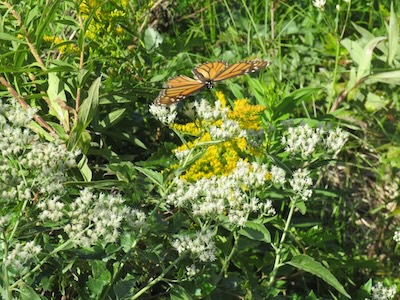
Monarch butterflies need every flower they can find during fall migration.
September 23, 2026 - Each fall, one of nature’s great migrations passes through Texas. Monarch butterflies that spent the summer across much of the United States and southern Canada begin moving south toward their wintering grounds in the mountains of central Mexico. For many of them, Texas is the final major stretch of their remarkable journey.
We often hear about planting milkweed for declining monarchs, and rightly so. Milkweeds are the only plants monarch caterpillars can eat, making them essential for monarch reproduction. But during fall migration, adult monarchs have a more urgent need. They need nectar, and lots of it.
Migrating monarchs must continually refuel as they travel hundreds or even thousands of miles. Nectar provides the carbohydrates they need for flight and helps them build fat reserves needed to survive the winter in Mexico. A landscape filled with fall-blooming flowers can serve as a much-needed filling station along their southbound route.
Fortunately, Texas gardeners have many excellent choices. Some of our best fall nectar plants are natives that are naturally adapted to our climate and soils. Goldenrods are among the most valuable. Their masses of yellow flowers provide nectar and pollen for monarchs along with native bees and many other beneficial insects.
Native asters are equally valuable. Their lavender, blue, purple, or white flowers appear when many summer flowers are fading. Frostweed is another outstanding native nectar source. Its clusters of white flowers are frequently covered with monarchs and other butterflies during fall migration.
Other good native choices include Gregg’s mistflower, blue mistflower, Turk’s cap, blazing stars, ironweed, Joe-Pye weed, sunflowers, bonesets, and salvias. In sunny gardens, lantana, zinnias, cosmos, pentas, and other long-blooming ornamentals can also provide valuable nectar well into fall. However, if in doubt, just make sure you grow something each fall with colorful flowers.
The key is diversity and continuous bloom. A garden with several different kinds of flowers is more useful than one containing only a single nectar source. Plant flowers in masses where butterflies can easily find and feed from them. Sunny locations are especially useful because monarchs need warmth for active flight and feeding.
One of the easiest ways to help is simply to quit cleaning up the garden so quickly in the fall. We sometimes remove perfectly good flowering plants because the calendar says summer is over. If asters, goldenrods, salvias, zinnias, lantanas, or other nectar plants are still blooming, leave them alone until the first hard freeze. To a migrating monarch, those flowers are essential food.
Avoid unnecessary insecticide use on flowering plants as well. A butterfly garden cannot function as butterfly habitat if the insects visiting it are exposed to insecticides. Accepting a little cosmetic damage is a small price to pay for a living landscape.
Supporting monarchs, our state insect, does not require a special butterfly garden. It simply requires making room for flowers. Plant native species, preserve naturally occurring wildflowers, allow existing ornamental plantings to bloom, and keep nectar available throughout the fall migration season.
Texas lies in the heart of the monarch migration corridor. That gives Texas gardeners both an opportunity and a responsibility. Every patch of nectar-rich flowers, whether in a backyard, schoolyard, park, pasture, roadside, or public garden, can become one more refueling stop on an extraordinary journey south.