



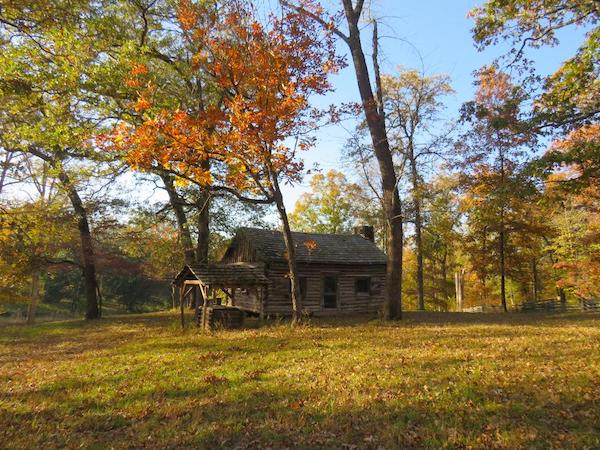
Mrs. Lee’s cabin is nestled in a beautiful natural open woodland.
December 3, 2025 - When I first visited Mrs. Lee’s Daffodil Garden around forty years ago, I left a note in their suggestion box letting them know that they needed to cut or thin some trees in order to keep the daffodils blooming. I was teaching horticulture at Stephen F. Austin State University at the time and had my own little hobby heirloom bulb farm. Daffodils are native to sunny meadows in Europe and will stop blooming if they do not get enough winter and early spring sunlight to store critical energy for the next year’s bloom.
Due to fire suppression and benign neglect, the beautiful nearly thousand-acre property that Helen Lee shared with the public experienced mesophication, the gradual change from open woodland to closed canopy forest that has occurred across much of East Texas and the South. As shade-loving trees and understory plants fill in, sunlight no longer reaches the ground, and plants adapted to open conditions, like daffodils and native grasses, begin to disappear.
Fortunately, the new management at Mrs. Lee’s has recently taken steps to restore the natural balance of the land. Careful thinning of trees and selective clearing have opened the canopy once again, allowing sunlight to reach the ground and reviving the conditions the daffodils need to thrive. The results will be stunning. Not only will millions of daffodils continue to bloom across the rolling hills each spring, but the property is also reclaiming its character as a healthy East Texas pine-oak-hickory woodland filled with wildflowers, birds, and pollinators.
This kind of restoration work benefits more than just the daffodils. By restoring sunlight to the forest floor, native grasses and wildflowers are able to return, which in turn support birds, bees, butterflies and biotic diversity. Thinning the dense canopy also improves tree health by reducing competition for light, water, and nutrients, while creating better habitat for wildlife such as bluebirds, woodpeckers, and squirrels.
Mrs. Lee’s Daffodil Garden has long been a beloved local treasure, a place where people can witness one of the most breathtaking floral displays in Texas each spring. The combination of golden daffodils, quiet ponds, towering oaks, pines, and hickories makes it a peaceful retreat and an invaluable educational resource. Thanks to the renewed management practices, future generations will be able to enjoy this spectacle in full bloom rather than watching it fade under the shadow of unchecked woody vegetation.
This restoration effort also provides an important lesson for all landowners and gardeners. Whether you care for a thousand acres or a backyard, sunlight is a critical ingredient for a diversity of flowering plants. Periodic thinning, pruning, and clearing of invasive plants can make the difference between a struggling landscape and a thriving one. Just like our beloved daffodils, jonquils, and narcissus, gardens need the right balance of light to stay in bloom year after year.
If you have never visited Mrs. Lee’s Daffodil Garden, mark your calendar for late February or early March. The season of bloom depends on the weather, but the show is always worth the wait. As the flowers reawaken under their restored canopy of light, they remind us that with good stewardship and respect for nature, beauty can endure for generations.
For seasonal updates, you can follow their progress on Facebook at The New Mrs. Lee’s Daffodil Garden.
Greg Grant, Ph.D., is the Smith County horticulturist and Master Gardener coordinator for the Texas A&M AgriLife Extension Service in Tyler. He is the author of Texas Fruit and Vegetable Gardening, Texas Home Landscaping, Heirloom Gardening in the South, and The Rose Rustlers. You can read his “Greg’s Ramblings” blog at arborgate.com, read his “In Greg’s Garden” in each issue of Texas Gardener magazine (texasgardener.com), or follow him on Facebook at “Greg Grant Gardens” or “Pines, Pawpaws, and Pocket Prairies.” More science-based lawn and gardening information from the Texas A&M AgriLife Extension Service can be found at aggieturf.tamu.edu and aggie-horticulture.tamu.edu.