



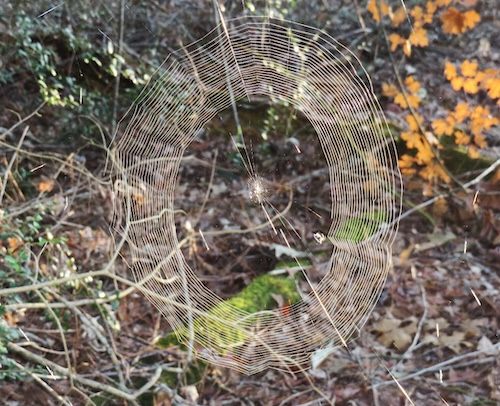
A spiny orb weaver showcases her spinning talents in Greg’s woods.
October 30, 2025 - As autumn rolls in and Halloween decorations begin to creep across our neighborhoods, spiders suddenly take center stage. From fake cobwebs stretched across porches to real orb weaver webs along my woodland trails, the season celebrates these eight-legged creatures as symbols of mystery and fright. But behind their spooky reputation lies one of nature’s most beneficial and fascinating allies.
Spiders are not insects. They belong to the class Arachnida and are entirely carnivorous. Unlike pests that feed on plants, spiders prey on insects, making them some of the most effective and natural pest-control agents in our gardens. A healthy landscape can host hundreds of spiders per square yard, quietly consuming mosquitoes, flies, caterpillars, beetles, and leafhoppers that would otherwise damage plants or spread disease.
A spider web glistening with dew on a fall morning represents one of the most efficient hunting tools in nature. Orb-weaving spiders, the ones most associated with Halloween, construct intricate circular webs to trap flying insects. Other species, such as wolf and jumping spiders, actively stalk their prey on the ground or among leaves. Regardless of their hunting method, all spiders play an important role in keeping insect populations in balance.
Spiders also serve as food for birds, frogs, lizards, and wasps, connecting them to the larger food web that keeps ecosystems healthy. They are both predators and prey, critical links in maintaining the natural balance of life.
Contrary to popular belief, most spiders are harmless to humans. Of the nearly 900 species found in Texas, only two, the black widow and the brown recluse, are considered venomous, and neither is likely to be found in a garden. Garden spiders such as the yellow and black argiope, often seen in home gardens, are completely harmless and can be enjoyed up close as they weave their beautiful webs. As a kid I’d toss hapless insects into the webs to watch her subdue them. Heck, I still do!
Spiders are also indicators of environmental health. Overuse of pesticides can unintentionally harm them, reducing their numbers and allowing pest insects to rebound unchecked. To encourage beneficial spiders in your garden, avoid broad-spectrum insecticides and instead rely on nature’s own balance.
It seems fitting that spiders are associated with Halloween, a season of mystery and transformation. Their presence reminds us that even the most misunderstood creatures have a purpose in nature’s grand design. So this fall, when you see a web stretched between two branches or a patient orb-weaver waiting in its silky trap, take a moment to appreciate it.