


By Susannah Arden Tiemyer
September 28, 2026 - In our September meeting, members and guests of the Timpson Area Genealogical and Heritage Society gathered to hear special guest speaker Cindy Rhodes. Rhodes is a retired social studies teacher who taught middle and high school students in Timpson for many years. She stepped away from full-time teaching in 2011 to take care of her family. Her husband Bobby had retired earlier in 2007 to care for their newborn granddaughter, who is now 19 years old. When their second granddaughter turned one year old, Cindy retired as well. Standing in front of a class again made her feel a little nervous at first. However, she told the audience that teaching was just like riding a bike. Once you get back on, you start pedaling right away.
The meeting opened with welcoming words from Society leaders Brandy Harding and Shannon Ramsey. Ramsey lives right across the fence from Rhodes in rural Shelby County. He praised Rhodes for her dedication to local history. He noted that she writes historical and other interesting articles every month for the Tap Root and has done so for the past 14 years. Harding reminded everyone about a Christmas drawing coming up in December. Members who attend meetings can win free Ancestry DNA kits and family history record books to track their family trees.
Before starting her presentation, Rhodes made one point very clear to the room. Her talk was not about picking sides between Democrats and Republicans. Instead, she called it an 'American thing.' Her father-in-law spent four full years fighting in Europe during World War II, ruining his health in defense of freedom. That sacrifice gave her a deep love for the country. Rhodes believes that every citizen should understand how our government and economy work. That knowledge helps us make smart decisions and protect our freedom.
Democracy vs. Republic: What Kind of Country Is America?
Rhodes began her lesson by asking the audience a simple question: Is the United States a democracy or a republic? Several people in the room answered that America is a republic. Rhodes smiled and explained that both answers are correct. The United States is officially a Democratic Republic. Knowing the difference between these terms helps us see how our rights stay safe.
The word 'democracy' comes from the ancient Greek language. It joins two smaller words: 'demos,' which means people, and 'cracy,' which means rule or government. So, democracy literally means 'rule by the people.' Thousands of years ago, the city of Athens in Greece used a direct democracy. About 300 male citizens met in an open arena to vote on every law. Every citizen had one direct vote on every decision. That worked for a tiny city back then, but it cannot work for a big country today.
Rhodes noted that America has about 400 million people today. There is no stadium or building on Earth big enough to hold every voter at the same time. The biggest sports stadium in the world holds only 120,000 people. That is far too small for millions of voters. In Texas, the only time citizens vote directly on a law is when a state amendment comes up on the ballot. Voting on regular propositions just tells leaders what we prefer.
Because direct democracy is not possible for a large nation, America uses a representative democracy and a republic. The word 'republic' comes from the Latin phrase 'res publica,' which means public good or public affairs. The ancient Romans created the first republic, which lasted until Julius Caesar died in 42 B.C. In a republic, citizens elect leaders—like congressmen, senators, governors, and city council members—to vote on laws for them.
Rhodes pointed out that leaders are supposed to vote the way their voters want them to vote. She shared that her husband Bobby writes letters, makes phone calls, and sends emails to elected leaders every week. Even if a leader sends back a form letter, someone in the office reads the message. Rhodes reminded citizens that staying in touch with elected leaders keeps representative government working.
Civics Rule: Democracy vs. Republic
In a pure democracy, the majority rules everything. If 51 percent of the people vote to take away your rights, you lose them. In a republic, the Constitution sets firm laws that protect individual rights for everyone, even if the majority disagrees.
The Electoral College: Protecting Small Towns and Country Voters
Next, Rhodes talked about the Electoral College. You often hear people on the news arguing that America should get rid of the Electoral College. They want the president picked only by counting total votes across the whole country. Rhodes explained why the Founders created the Electoral College and why it still matters to rural communities today.
To make her point easy to understand, Rhodes compared local towns with big cities. The whole of Shelby County, Texas, has about 25,000 residents. Most people in Shelby County live in the country and care about farming, small local shops, and good rural roads. On the other hand, the city of Houston has about 4 million people. Houston is the fourth largest city in the United States. Driving just 150 miles down the road brings you to a big city where people think very differently.
If America chose its president by total popular vote alone, candidates would spend all their time in big cities like Houston, Dallas, New York, and Los Angeles. They would ignore small rural towns completely. Big cities would make all the rules for everyone else. The Electoral College spreads out voting power across every state. This makes sure that small towns have a fair voice in picking our national leaders.
Rhodes expressed great respect for the U.S. Constitution. She called it the most wonderful government document ever created, second only to the Bible. Over 250 years, the U.S. Constitution has been changed only 27 times through amendments. By contrast, the Texas state constitution gets updated dozens of times during almost every state election. The steady national Constitution keeps our core freedoms safe year after year.
How Economics Works: The Four Factors of Production
After discussing government types, Rhodes turned to economics. An economic system is the plan a country uses to make, sell, and share goods and services. Every economic system must answer three main questions: What resources do we have? How do we make things? How do we deliver products to the people?
To show how resources matter, Rhodes spoke about energy and foreign trade. The United States is rich in many natural resources, but it has very little natural uranium. Uranium is a special metal needed to make nuclear power and defense weapons. Because America needs uranium, it builds friendly ties with countries that have large supplies, like China, Russia, and Ukraine. This economic need helps explain why America stays involved in world events.
Rhodes explained that up until the late 1800s, most Americans were farmers. By the 1900 census, America became an urban society as people moved to cities. When people moved to cities, businesses had to step in to provide food and goods. Every business or country relies on four basic factors of production:
1. Land: Natural resources provided by Earth, such as land, water, oil, timber, and crops. Rhodes shared a funny story from her teaching years. A student once asked why farms were needed when people could just buy green beans at Walmart. Rhodes reminded the student that canned vegetables do not grow on store shelves. They must grow in real dirt on farms first.
2. Labor: Human work and labor. Finding steady labor has been a big topic in American history. Early colonial settlements like Roanoke failed because settlers could not survive the tough workload. Early settlers tried forcing Native Americans to farm, but in Native American tribes, women did the farming while men hunted. Settlers then brought enslaved Africans to work, leading to the Civil War. Today, our labor force consists of everyday workers, including teachers and preachers. Rhodes joked with local pastor Levi Cohorst that preachers work only three hours a week!
3. Capital: The money, tools, and machines needed to build factories and run shops. As Rhodes put it, money makes the economic world go round. Without capital, new ideas cannot turn into real businesses.
4. Management: The business owners, bosses, and managers who organize land, labor, and capital. Good managers keep work organized so that businesses run smoothly instead of falling into total confusion.
Moving Goods: From Covered Wagons to Flying Drones
A growing economy needs a reliable delivery system to move goods from farms and factories to families. Rhodes gave a quick history lesson showing how transportation has changed over the past two centuries.
In the 1700s and early 1800s, families moved goods across the country in covered wooden wagons along paths like the Oregon Trail. Travel was slow and hard. In the 1820s, steam trains began running on iron tracks. Transport grew rapidly in 1869 when workers finished the Transcontinental Railroad, linking the East Coast all the way to the West Coast.
Later, cargo ships and airplanes made shipping even faster. The opening of the Panama Canal saved ships from traveling 11,000 extra miles around South America. Today, modern shipping networks move goods across the globe in hours instead of months.
Rhodes shared a fun story about new delivery technology. While exploring Waco, Texas, she and her husband Bobby saw a strange flying device lift off from a huge Amazon distribution building. It was an unmanned delivery drone. The drone flew over a street, dropped a package safely in a neighbor's yard, and flew back. While seeing drones in small towns might take time, delivery methods keep getting faster.
The Duties of Government: Keeping Citizens Safe
Rhodes explained that governments have two main jobs: protecting citizens from outside attack and protecting citizens from internal crime. Without these two safeguards, people cannot live in peace.
First, a nation must defend its people from foreign enemies. Oceans on both sides of America provided natural protection for a long time. However, sudden attacks like Pearl Harbor in 1941 and 9/11 in 2001 proved that a country must always stay prepared. Rhodes praised the men and women serving in our military, including local high school graduates who join the armed forces.
Second, governments maintain safety at home through local police and court rules. Rhodes noted that human beings are born with a sinful nature, and rules are needed to stop people from stealing or hurting others. She pushed back against ideas to get rid of police departments, arguing that social workers cannot replace law enforcement when dealing with criminals.
Rhodes also noted that citizens pay for government safety nets like Social Security. She stressed that Social Security is not a government handout because working citizens pay into it during their careers and deserve to receive it back. She also spoke about international trade deals like NAFTA and security groups like NATO, as well as diplomatic efforts by leaders like Steve Lutnick and Jared Kushner to build peaceful ties with other countries.
Absolute State Control: Fascism and Nazism
To help people understand political ideas, Rhodes described several historical systems. She started with Fascism and Nazism, which give the government total power over the individual.
Fascism is a strict government system based on extreme nationalism, a powerful dictator, and total state control over every person. Under Fascism, citizens have no personal freedom. The government controls newspapers, radio stations, and businesses. Anyone who speaks out against the leader gets punished or killed.
Rhodes explained that Fascism started in Europe after World War I. Anton Drexler created the German Workers' Party in 1919. Adolf Hitler joined the group and built it into the National Socialist German Workers' Party (Nazi Party) in 1921. Hitler wrote down his extreme ideas in his 1925 book, Mein Kampf.
Rhodes mentioned watching a History Channel documentary about Hitler's blood DNA, which showed signs of bipolar disorder and ADHD. His writings were filled with hatred toward Jewish people, anti-communism, and a strong hatred of representative democracy. In Nazi Germany, secret police forces executed families caught listening to foreign radio news like Voice of America. Rhodes emphasized that Fascism removes all personal choice.
Group Control Systems: Socialism and Communism
Rhodes then explained collectivist systems, focusing on Socialism and Communism. Both of these ideas want group or state control of property instead of private land ownership.
Socialism tries to make everyone equal by having the government own and run major industries. Supporters claim this creates a fair society. However, Rhodes explained that taking away private property removes the reward for working hard. She noted that many famous socialist leaders today have become millionaires themselves, showing that these ideas rarely work out as promised.
Rhodes pointed out a biblical story from the Book of Acts in the Bible. In Acts chapter 2 and 3, early Christians in Jerusalem shared their possessions voluntarily under God's guidance. However, modern human-run socialist governments fail because of human greed. She also noted that recent political bills, like Bernie Sanders' proposal for a 32-hour workweek with 40 hours of pay, raise real questions about who pays the extra costs.
Rhodes mentioned early thinkers behind socialism, including Robert Owen, who set up shared farming communities, and Henri de Saint-Simon. Later, Karl Marx wrote about a struggle between workers and rich business owners.
Communism is an extreme form of socialism that seeks to wipe out all private property completely. Under communism, one ruling party controls all farms, factories, stores, and news outlets. Historically, communist governments used harsh force to stay in power, sending people who disagreed to cold labor camps in Siberia.
Rhodes recalled what grocery stores looked like in the old Soviet Union. Store shelves were often completely empty, lacking basic items like bread, milk, and paper towels. She described how Soviet leader Vladimir Lenin took farmland away from families and forced them to live in city apartments while working on state farms for no extra pay.
No Rules vs. Free Choice: Anarchism and Capitalism
Rhodes then compared the idea of Anarchism with Free Market Capitalism.
Anarchism is the belief that all governments, laws, and police should be done away with. Anarchists claim that people are naturally good and do not need rules. Rhodes disagreed, using a funny driving example. She said that if there were no speed limits, she would be tempted to drive 85 miles per hour to Waco, risking a terrible crash on sharp turns. Without laws, society turns into complete chaos.
Rhodes shared historical examples of anarchist trouble, such as the Haymarket Square Riot in Chicago on May 3, 1886. During a factory worker protest for an eight-hour workday, someone threw a bomb into a crowd of police officers, causing deaths and injury. She also mentioned writer Joseph Proudhon, who wrote What Is Property? in 1840 and called for ending government rules.
In sharp contrast, Capitalism is an economic system based on private property, free choice, and personal profit. Scottish writer Adam Smith described these ideas in his 1776 book, The Wealth of Nations. Capitalism allows individuals to start businesses and keep the money they earn.
Rhodes stressed that capitalism gives people freedom to choose their own future. In communist countries like China, young kids take government tests at age five and as teenagers that decide whether they work in factories or go to school. In contrast, American capitalism allowed Rhodes to decide when she was eight years old that she wanted to be a history teacher—a goal she freely chose and achieved.
Capitalism in Real Life: Gas Prices in East Texas
To show how capitalism works in daily life, Rhodes talked about gas prices along East Texas roads. She pointed out that gas prices change from town to town and store to store.
For example, while driving through Palestine, Mexia, and Waco, Rhodes saw gas prices shift within just a few miles. In one town, gas cost $3.29 a gallon. A mile down the road, another station charged $3.59, and a third charged $3.89. In Waco, store clubs like Sam's Club charged $3.19, while an H-E-B store across the street charged $3.49. In Timpson, prices differed between Brookshire's and the Quick Stop, and prices shifted further down the road in Garrison and Appleby.
Rhodes explained that gas prices change because of free market competition. Business owners set prices based on costs, location, and competition. The government does not set local gas prices. This freedom to compete keeps businesses trying hard to earn your business.
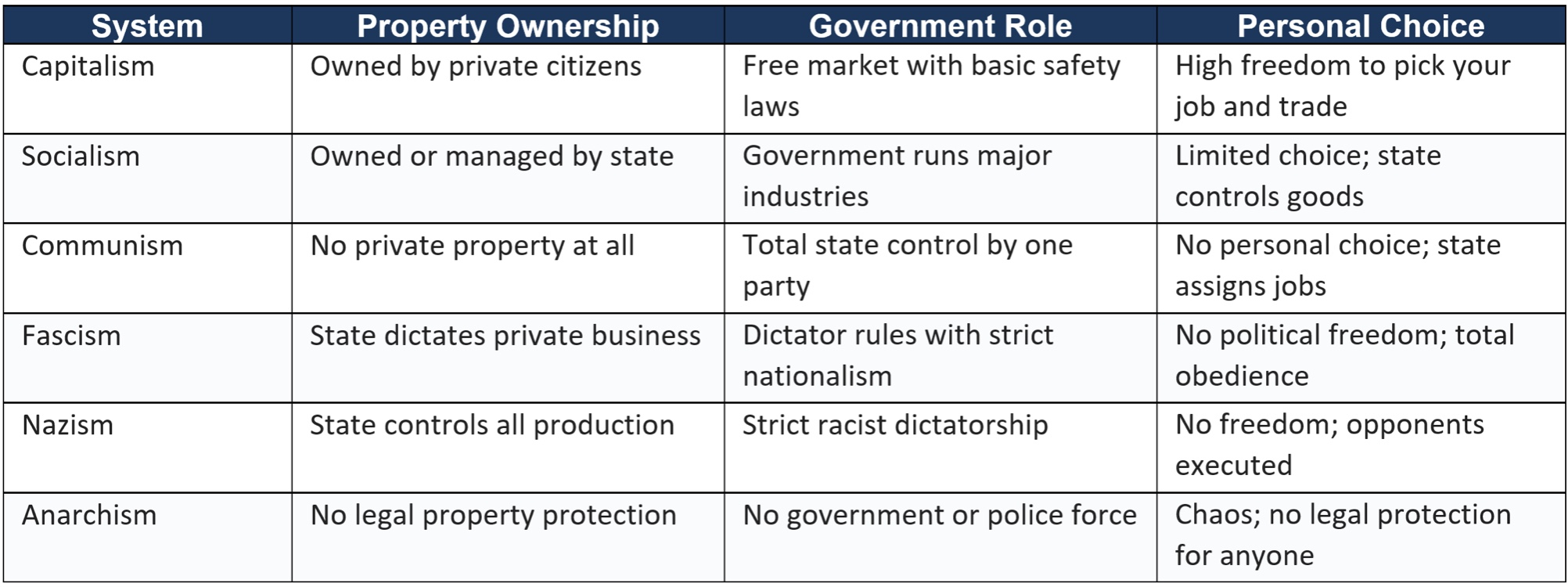
Quick Guide to Political and Economic Systems
To help everyone remember the main differences, Rhodes summarized how each system handles property, rules, and personal choice.
The Two-Cows Joke: Political Ideas Explained with Country Humor
Rhodes finished her talk by sharing a classic country joke that uses cows to explain government types:
- Socialism: You have two cows. You give one cow to your neighbor.
- Communism: You have two cows. You give both cows to the government, and the government might give you a little milk back.
- Fascism: You have two cows. You give all the milk to the government, and the government sells the milk and keeps the money.
- Nazism: You have two cows. The government shoots you and takes both cows.
- Anarchism: You have two cows. You keep both cows, shoot the government, and steal another cow.
- Capitalism: You have two cows. You sell one cow, buy a bull, and grow a whole herd of cows.
Local Reflections and Society News
The meeting concluded by presenting Rhodes with a Certification of Appreciation. It was noted that her presentation felt like an essential high school civics course and several expressed their belief that high school students today ought to spend a full semester studying these vital political and economic principles. A deeper foundational understanding of constitutional governance and economic systems is essential for young citizens to prepare to participate in democratic elections.
Society President Brandy Harding reminded everyone present that during the December meeting, the Society will host a festive holiday drawing featuring three Ancestry DNA testing kits alongside a hardbound family history journal. She encouraged attendees to enter the contest through the blue drawing box during monthly meetings leading up to the December meeting, underscoring the Society's ongoing dedication to preserving local heritage and community fellowship. Those not in attendance at the meetings can drop by the Genealogy Library during the week to enter the drawing.
The Timpson Area Genealogical and Heritage Society (TAGHS) meets at 2PM on the third Wednesday of each month in the meeting room of the Timpson Public Library, located on the corner of Austin and Bremond Streets in Timpson, Texas. The public is always welcome.
Submitted by Shannon Ramsey