



 Private Elzie Beckett
United States Army, World War I
Company A, 65th Pioneer Infantry
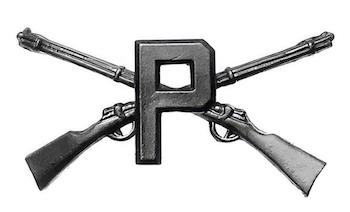
November 16, 2026 - Elzie was born on October 13, 1886 in the far east Texas town of Center, which serves as the county seat of Shelby County. Just two weeks following his birth, the Statue of Liberty would be dedicated with a parade in New York City. His parents were Amanda Greer and Harrison Beckett, and he is believed to have had four brothers: Pernel, Arthur, Claude, and Greer.
The United States entered the World War on April 6, 1917 with a declaration of war on Germany. The Selective Service Act passed the following month authorized the United States government to raise a national army for service in the war through conscription. The first of three registration was held on June 5, 1917 for all men between the ages of 21 and 30. Elzie now age 30 complied and completed his registration card at Precinct 6 in Jasper County, Texas. It noted his residence as Jasper, employment as a clothes cleaner, single, negro race, no prior military service, and no exemption to the draft was claimed. Physically he was described as of medium build and height with dark brown eyes, and black hair, and was not bald.

Thirteen months later, Elzie received his draft notice and took the oath of enlistment in Jasper, Texas on July 31, 1918. Becoming US Army Private Beckett, serial # 1104093, he and the other inductees of the day were entrained to Camp MacArthur, Waco, Texas for basic training with Recruit Company # 2 (Colored). Following basic, he was assigned to the African American Company A, 65th Pioneer Infantry, Camp Funston, Kansas. They trained for two months but never served overseas as the armistice ending the World War was signed on November 11, 1918. The 65th was demobilized and Private Beckett was honorably discharged on January 8, 1919. He and all other World War I Veterans were awarded the World War I Victory Medal which became available the following year.
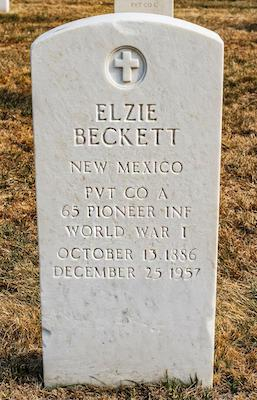
Following the war, Elzie and Miss Lena Lyles were married in Haskell, Texas on April 21, 1920, and lived in Coleman where he was employed as a cotton yard laborer. From this time, 1920 to his death at the age of 71 on Christmas Day, 1957, his life is not well documented. It appears he died while living with a son, Leroy in New Brunswick, New Jersey. The Quartermaster Form 14, Report of Interment shows he was buried in the Beverly National Cemetery, Beverly, Burlington County, New Jersey on January 3, 1958. Elzie is believed to have had two other sons, Jessie, and Leonard. Day is done, God is nigh.
Sources:
(1): Year: 1900; Census Place: Justice Precinct 5, Shelby, Texas; Roll: 1669; Page: 8; Enumeration District: 0090
(2): Registration State: Texas; Registration County: Jasper County
(3): McMahon, Margaret Ph. D. A Guide to the US Pioneer Infantry Regiments in WW I. 2023.
(4): Ancestry.com. Texas, U.S., County Marriage Records, 1817-1965 [database on-line]. Lehi, UT, USA: Ancestry.com Operations, Inc., 2016.
(5): Year: 1920; Census Place: Coleman, Coleman, Texas; Roll: T625_1788; Page: 12B; Enumeration District: 48
(6): Ancestry.com. U.S., National Cemetery Interment Control Forms, 1928-1962 [database on-line]. Lehi, UT, USA: Ancestry.com Operations, Inc., 2012.
The Pioneer Infantry - World War I - Who Were They?
An unknown Pioneer Infantry Officer described the Pioneer Infantry troops in these words: “They did everything the Infantry was too proud to do, and the Engineers too lazy to do.”
The Pioneer Infantry were similar to regular army troops in that they were trained in infantry tactics, but they were also trained in combat engineering. They were non-divisional, regimental troops and were not to be permanently part of any division but would be attached to armies or corps on an as-needed basis. Each was designed as either Corps or Army troops.
The duties of the Pioneer Infantry Regiments have been summarized as clearing and repairing roads ahead of the infantry troops, and repairing roads and installation immediately after attacks. They also did their share of loading and unloading materials from all forms of transport. They operated stone quarries and made concrete blocks. They stood guard duty on ammunition dumps, tunnels, and bridges. They strung barbed wire for the Allies, and removed barbed wire left by the Germans. They found and buried dead soldiers from both sides. They guarded prisons. They built structures and salvaged abandoned equipment. They worked repairing, building, and changing gauges of the tracks for the railroads bringing troops and supplies to the front.
The Pioneer Infantry Regiments were numbered between 1 and 817. 37 PIR were organized. 10 were authorized, but never organized. 770 were never organized.
Of the 37 Regiments that were organized, 26 went overseas and 15 saw combat. There were 17 African American Regiments (6th, 801st – 816th). Of the 17, 14 went overseas and 7 of them saw combat (802nd – 808th).
Four of the PIR and one band served in the Army of Occupation: 1st, 51st, 54th, Pioneer Infantry Regiments and the 55th Pioneer Infantry Band.
Each PIR contained 3,551 enlisted men and had a Regimental Headquarters, a Headquarters Company, a Supply Company, a Medical Detachment, and three Battalions. The African American Regiments had white officers with some of their men rising to the noncommissioned officer ranks. Their chaplains and dentists were African American, and were officers.
Source:
McMahon, Margaret Ph. D. A Guide to the US Pioneer Infantry Regiments in WW I. 2023.