

Click any story headline to open the article and share it using social media: Facebook, Twitter.



October 16- October 20
Rated PG-13. Ends at 9:05pm
Coming Soon:
Closed Wed. & Thurs.
Box office opens 7pm
Admission:
Adults $8, Children $7
Senior Citizens (Mondays) $6
936-598-3864
Click any story headline to open the article and share it using social media: Facebook, Twitter.
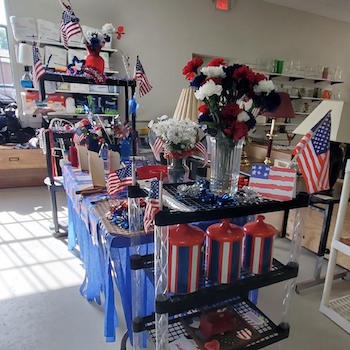
June 15, 2022 - The Unique Boutique has an excellent selection of swimwear and summer clothes! We also have our Fourth of July decorations out, so come by the store today and celebrate Independence Day in style. The Unique Boutique has a Yellow Tag Sale going on currently. Everything with a Yellow Tag is 50% off!

The Unique Boutique is open Monday thru Friday from 9-4. All proceeds go directly back into our programs that help feed the hungry and assist the needy in Shelby County. For more information, please give us a call at 936-591-8190.

June 14, 2022 - Vanessa Renteria-Lopez received her SSP - Specialist, School Psychology degree during the 2022 Spring semester at Sam Houston State University.
Vanessa is a 2015 Center High School honors graduate. In 2016 she was inducted into the Phi Beta Chapter of Phi Theta Kappa National Honor Society while attending Panola College. At Stephen F. Austin State University she was named on the Dean's List multiple times before graduating with a degree in Interdisciplinary Studies.
June 14, 2022 - The Center Noon Lions Club would like to thank the many businesses that donated to make the Center Noon Lions Club Chicken Dinner Fundraiser a great success.
Endless Possibilites Catering, H & S Discount Food, Tyson Foods, INC., Wal-Mart Supercenter, and Whataburger No. 964 each contributed generously.
In addition KDET-AM Radio, Shelby County Today, and The Light and Champion helped get the word out to the community.
Thank you to the Center Fire Department for use of their fire pits to cook the chicken as well as the building to stage the lunches and the John D. Windham Civic Center for use of the kitchen.
Having businesses that support Lions truly helps make Center, Texas such a great place to live and raise a family.
Center Noon Lions will continue to use the funds raised wisely and efficiently to help those in need. Over one million dollars have been raised by the Center Noon Lions Club thanks to the help from local businesses.
Again, a heartfelt "THANK YOU" from the Center Noon Lions Club.
June 14, 2022 - The Fannie Brown Booth Library will be closed Tuesday, June 14th, due to the air conditioner being out. We will open Wednesday, June 15th, if we can get the air working.
June 13, 2022 - Brittany Hicks and Milagros Luna, both from Joaquin, Texas, were among students named to the Spring 2022 Dean's List at LeTourneau University. The Dean's List recognizes students who have achieved a grade point average between 3.50 and 3.99 for the semester.
Brittney Hicks is pursuing a Bachelor of Interdisciplinary Studies degree and Milagros Luna has achieved a Bachelor of Business Management degree.
LeTourneau University President Dr. Steven D. Mason said being named to the Dean's List is a significant academic achievement and honor.
"As the comprehensive Christian polytechnic institution in the country, LeTourneau University attracts students who are among our nation’s best,” Mason said. “I'm especially impressed with these honor roll students, and I expect them to have a significant impact on our future."
LeTourneau University is the Christian polytechnic university where educators engage students to nurture Christian virtue, develop competency and ingenuity in their professional fields, integrate faith and work, and serve the local and global community. LETU offers more than 140 undergraduate and graduate degree programs online and at LETU’s residential campus in Longview, Texas, located 120 miles east of Dallas, Texas, and 60 miles west of Shreveport, Louisiana.
Claiming every workplace in every nation as their mission field, LeTourneau University graduates are professionals of ingenuity and Christ-like character who see life's work as a holy calling with eternal impact. For additional information, visit www.letu.edu.
June 13, 2022 — LeTourneau University held spring 2022 commencement services recently for around 200 graduates who received bachelor's and master's degrees. Among them was Milagros Luna, a 2017 Graduate of Joaquin High School, who graduated with a Bachelor of Business Management degree.
LeTourneau University is the Christian polytechnic university where educators engage students to nurture Christian virtue, develop competency and ingenuity in their professional fields, integrate faith and work, and serve the local and global community. LETU offers more than 140 undergraduate and graduate degree programs online and at LETU’s residential campus in Longview, Texas, located 120 miles east of Dallas, Texas, and 60 miles west of Shreveport, Louisiana.

June 9, 2022 - Shelby County Chamber of Commerce Ambassadors and community members gathered on June 2, 2022, at Perfectly Imperfect Nutrition in Center to help the business owners celebrate with a ribbon cutting.
Deborah Chadwick, Shelby County Chamber of Commerce President, vouched for the drinks and shakes at the location as she and her staff had already sampled some of the menu. She introduced owner Denise Hill and invited her to share some about the business.

Hill welcomed everyone and introduced her husband Brandon and staff members Jennifer and Lisa, who work at assembling the drinks.
"We do Loaded Teas, we've got between 1200 to 1800 flavors, we have shakes, 600 shakes," said Hill. "I just want to welcome y'all into my home basically, this is our home, this is our team."
One intriguing option offered are Lava Shakes which come in flavors such as Balava Split, Key Lime A Lava, Lavaberry Cupcake, Lavapop Blast, PB and J'Lava, Pina Colava, or a flavor of your preference.
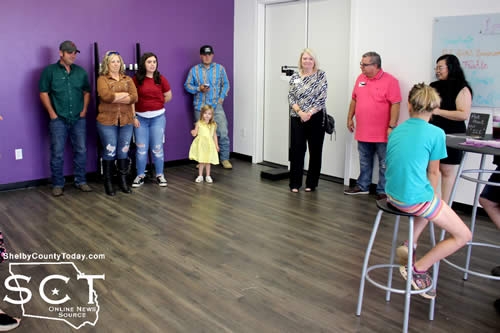
Some of the featured Loaded Tea flavors on the day of the ribbon cutting included Boss Lady, Aquaman, Toes in the Sand, Hot Girl Summer, Ninja Turtle, and Tropical Paradise amongst many more.
There also are several candy flavored Loaded Tea options.
The menu also include Donut Shots (Prolessa), Beauty Booster (Collagens), and Tea Drops.
For an almost dessert indulgence, customers can try the protein shakes with a long list of flavor options. On the day of the ribbon cutting, some of those options included Blueberry Muffin, Strawberry Cheesecake, Banana Pudding, Overstuffed Oreo, S'More, Mint Chocolate and Pineapple Upside Down Cake to name a very few. The list of all available options can be found at the business

There are several kids options which don't have any caffiene in them.
Perfectly Imperfect Nutrition is open every day Monday through Friday from 6am to 6pm and on Saturday 8am to 4pm and on Sunday from 9am to 3pm.
The store is located at 854 Hurst Street Suite 104 near the Little Caesar's Pizza.
There is delivery available on three or more drinks, as well as curbside service. Customers can call ahead, and their order can be prepared before they arrive. Credit cards and cash are accepted. Call 903-263-3504 to order ahead.
Click image to enlarge
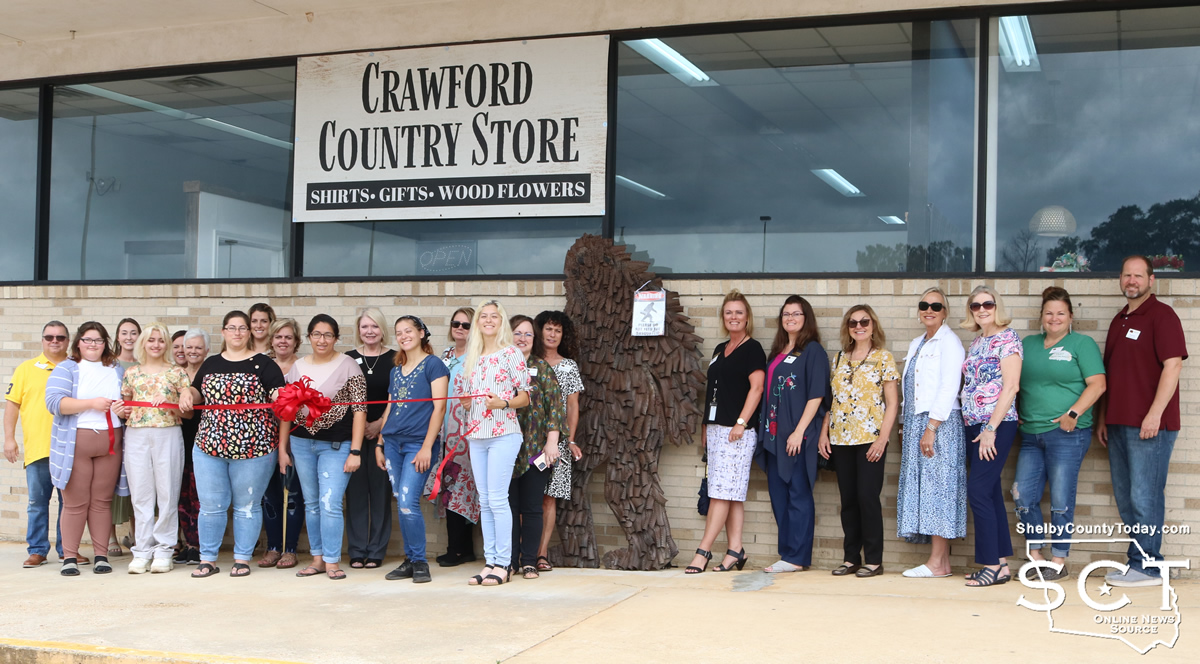
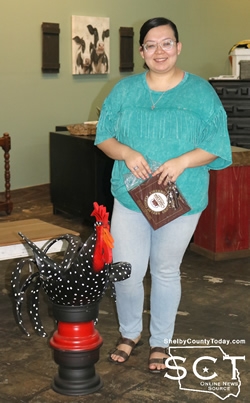
June 7, 2022 - Chamber of Commerce Ambassadors attended a New Member Ribbon Cutting at Crawford Country Store on Wednesday, June 1, 2022.
Deborah Chadwick, Chamber of Commerce President, welcomed everyone and expressed her excitement about the business coming to town and the awesome work done to the business location. She introduced Brandy and Shawn Crawford, owners of Crawford Country Store, and invited them to tell about their business.
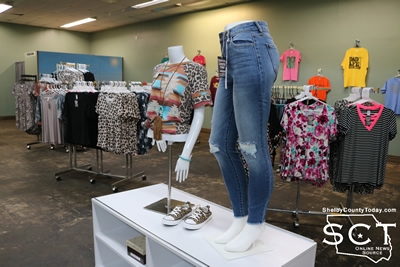
Brandy Crawford spoke about their family owned business, “We are new out here but we do live out in Bronson. We do have a couple of other locations and we do a monthly market as well. We do embroidery, screen printing. We do all of the boutique items… clothing, shoes, all the stuff that you guys see here. We also have our own wood shop and build and redo furniture as well. So, we can make custom items and all of those arrangement things. We also do the wood flowers for weddings, graduation, anniversaries… any of those things and we custom dye them and scent them.” Crawford spoke about future plans which include DIY type classes with flowers and craft kits for parties and ladies’ night out. The store has an ice cream shop in the back with fresh baked cookies and plans to expand in the fall to offer more items.
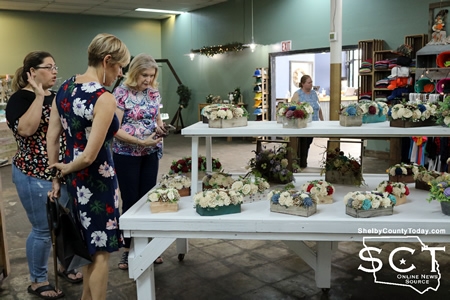
Crawford ended by expressing her appreciation of everyone coming to welcome them to the community.
Store hours are Tuesday through Thursday, 11am to 7pm, and Friday and Saturday, 11am to 8pm. Crawford Country Store is located at 1255 Tenaha Street, in the old CVS building, in Center.

Click above image for a larger version
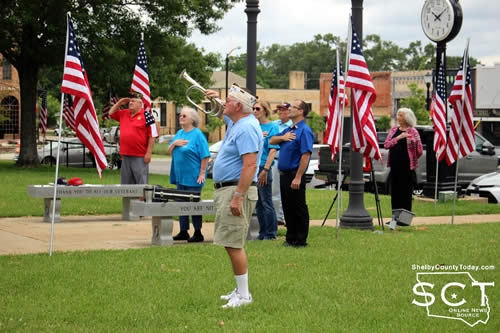
June 6, 2022 - VFW Post 8904 and Auxiliary held a D-Day remembrance ceremony, on its 78th Anniversary, at the Shelby County Veterans Memorial beside the Historic 1885 Courthouse on June 6, 2022.
Kenneth Ramsey, Post Chaplain, gave the opening invocation and Larry Hume, Post Quartermaster, led the program.
"D-Day was a turning point, June 6, 1944, in World War II and it saw the start of the largest air and sea operation in military history," said Hume. "On December 6 of 1943, President Roosevelt appointed General Dwight D. Eisenhower as commander of the cross channel operation."
Hume then played Eisenhower's preinvasion address for all to hear. After the audio finished, he described 156,000 troops were landed by the Allies, of which 73,000 were Americans.
"It's hard to conceive the epic scope of this battle that foreshadowed the end of Hitler's dream of Nazi domination," said Hume. "Overlord was the largest air, land and sea operation taken before or since June 6, 1944."
The landing included over 5,000 ships, 11,000 airplanes and over 150,000 servicemen.

"After years of planning and seemingly endless training for the Allied forces, it all came down to this," said Hume.
Hume wanted everyone to imagine they were in one of those LSTs (Landing Ship, Tank) going towards the shore, feel the vessel hit the bottom, the boat ramp going down. Then having to jump, swim, run, crawl through the cliffs. Many of those whoe were going to shore were not even 20 years old yet as they entered the surf carrying 80 pounds of equipment while facing over 200 yards of beach before reaching the first natural feature offering any protection to them.

"Blanketed by small arm fire and bracketed by artillary, they found themselves in hell," said Hume. "When it was over, the Allied forces had suffered nearly 10,000 casualties and more than 4,000 were dead; yet somhow, due to planning and preparation, and due to the valor and sacrifice of the Allied forces Europe had been breached."
There is no official tally of casualties for D-Day, but it's estimated at 10,000. U.S. Forces lost over 6,600 men.
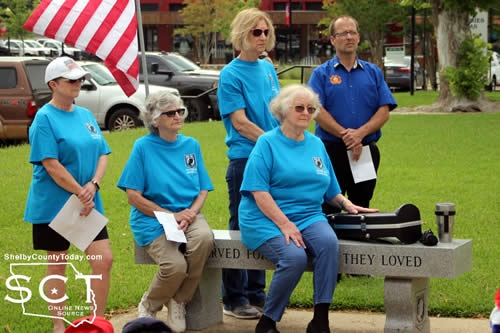
Those present for the event read the following names aloud:
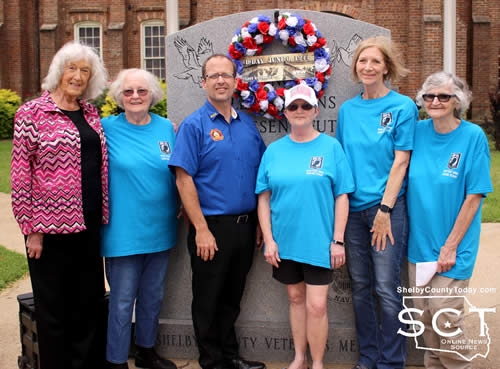
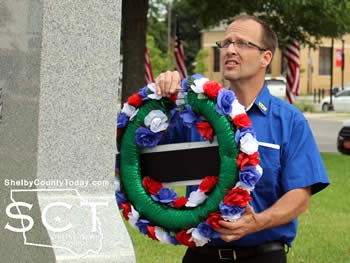
Gerald Spradlin, District 19 President-Elect from the Lufkin Post, then laid a memorial wreath upon the Shelby County Veterans Memorial.
Taps was then played, as presented by Gene Hutto, Post Commander.
During the program, Hume shared with everyone the passing of Post Life Member Webb Bates who passed away in Nacogdoches June 5. He was 74 and an Army Vietnam Veteran having served from December 1967 to December 1969.

June 6, 2022 - The New Hope Cemetery Association would like to thank Trent Sims and Project Cemetery for the beautiful flowers put out at the cemetery recently.
We had our annual homecoming yesterday and the cemetery was beyond gorgeous with all the color! The graves that don’t have anyone to put out flowers for them all had pretty flowers due to this sweet ministry! We cannot thank you enough!
New Hope Cemetery Association